
Few things derail a Sunday service faster than a wireless microphone cutting out or making noise mid-service. Wireless microphones give freedom to move, but they depend on an invisible radio spectrum and batteries that don't die at the worst moment.
Wireless technology is changing faster than at any time in decades. Analog systems are fading out, digital wireless has become the standard, and a new technology called WMAS is beginning to reshape how large wireless systems are built. Here's what church leaders need to know to choose, coordinate, and maintain a system that works every week and keeps working for years.
Start with how your church actually uses wireless
Before comparing brands, count your real needs. List everyone who needs a mic at your busiest service of the year (Christmas Eve and Easter usually win), not a typical Sunday.
Pastors and teachers usually do best with a headset or earset microphone, which stays at a consistent distance from the mouth.
Worship leaders and vocalists generally want handheld microphones with a capsule that suits their voice and rejects stage monitor bleed.
Instruments such as acoustic guitar, violin, or saxophone use bodypack transmitters.
Choirs, drama and children's programs may need several extra channels a few times a year.
In-ear monitors are also wireless systems and use the same spectrum, so include them in your count.
That channel count, plus a couple of spares, is what your system and frequency plan must support.
Analog wireless is on its way out
For decades, nearly every church wireless mic was analog: the transmitter sent a frequency-modulated radio signal, and a compander squeezed and expanded the audio to reduce noise. That approach worked, but the market has moved on.
Manufacturers are retiring analog lines. Shure replaced its original analog SLX years ago with the digital SLX-D, which in early 2026 was succeeded by the SLX-D+. Across the industry, new mid-range and professional product launches are digital.
Spectrum keeps shrinking. Since July 2020, wireless microphones have been prohibited from operating in the 617–652 MHz and 663–698 MHz ranges after the FCC's 600 MHz auction. Analog systems, which need wide spacing between channels, fit fewer microphones into the remaining space.
Analog is now mostly entry-level. Manufacturers still sell analog systems for simple, low-channel-count uses, but they no longer invest in new features. Entry-level system body packs produce more noise and less signal because they lack sufficient bias to make the most of high-quality lapels or earset mics, which require more power to work.
If your church still runs analog wireless, especially any gear in the 600 MHz range, now is the time to plan the move to digital.
Why digital wireless is now the norm
Digital wireless converts the microphone signal to digital audio before transmission. That brings real advantages to a church:
Cleaner, more natural sound. No compander means no pumping or breathing artifacts, with wide dynamic range for both a whispered prayer and a full-voice worship leader.
More channels in less spectrum. Many digital systems can be packed closer together, and some suffer far less from intermodulation, so a crowded room fits more microphones.
Encryption. Many systems offer AES-256 encryption, which keeps counseling sessions, prayer times, and private meetings from being picked up by a scanner.
Network audio and remote management. Dante outputs send audio directly to digital mixers, and software lets your tech team monitor battery life, signal strength, and interference from one screen.
Rechargeable batteries with runtime reporting. No more guessing whether a pack will last through the second service.
Brands we recommend
Advanced Sound & Communication designs church wireless systems around the leading names in the industry:
Shure (Niles, Illinois) – The most familiar name in worship audio. The new SLX-D+ adds ShowLink Ease two-way communication between receiver and transmitter, remote management and feedback suppression, making it a strong fit for small and mid-size churches. QLX-D and ULX-D step up for larger rooms, and Axient Digital serves high-channel-count productions. Shure's free Wireless Workbench software handles coordination and monitoring.
Sennheiser – The Evolution Wireless Digital (EW-D and EW-DX) lines bring digital performance to churches at accessible price points, with app-guided setup and very efficient frequency spacing. At the top of the range, Sennheiser leads the industry into WMAS with Spectera (more below).
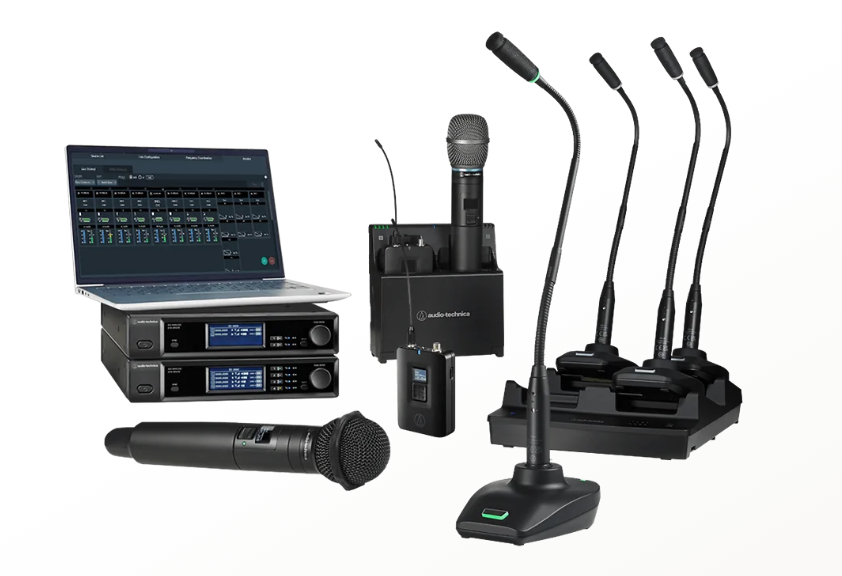
Audio-Technica (U.S. headquarters in Stow, Ohio) – The new D50 Digital UHF Wireless System, introduced at InfoComm 2026, was designed for high-density RF environments including houses of worship. It offers up to 138 MHz of tuning range in the U.S., AES-256 encryption, onboard spectrum analysis, internal DSP, and half-rack receivers with up to eight channels of Dante audio in a single rack space. For smaller rooms, the license-free System 20 PRO 2.4 GHz system scales to 20 channels with no frequency coordination.
Audix (Wilsonville, Oregon) – Audix entered professional digital wireless in 2026 with Novacore: 24-bit audio, AES-256 encryption, sub-3 ms latency, single, dual and quad receivers (with Dante on the dual and quad), and a price of roughly $699 per channel. Of special interest to churches, Novacore includes wireless MicroBoom choir microphones, plus retrofit kits to convert existing wired MicroBooms.
MiPro – Known for its one-touch ACT sync, MiPro offers the ACT-800 series of wideband, encryption-capable digital UHF receivers, including Dante-equipped dual and quad models. License-free 5.8 GHz (ACT-5800) and 2.4 GHz (ACT-2400) digital systems are a smart choice for classrooms, chapels and fellowship halls.
Lectrosonics (Rio Rancho, New Mexico) – An American manufacturer since 1971, built for broadcast, film and theater. The D Squared fourth-generation digital platform and Duet digital in-ear monitor system deliver studio-quality audio and rugged reliability, ideal for churches producing video or broadcast content.
The future: WMAS (Wireless Multichannel Audio Systems)
Every conventional wireless mic, analog or digital, is a narrowband system: one transmitter, one receiver channel, one frequency of up to 200 kHz. Each new mic means another frequency to coordinate. WMAS changes that model.
In February 2024, the FCC adopted rules allowing WMAS in the United States on both a licensed and unlicensed basis. A WMAS system combines many audio channels into a single wideband carrier, up to 6 MHz wide (the width of one TV channel). Unlicensed WMAS can operate at up to 100 mW, twice the power allowed for unlicensed narrowband microphones.
What WMAS means in practice:
Far more microphones per MHz. Instead of coordinating dozens of individual frequencies, you coordinate one wideband channel and add microphones as devices on it.
Two-way communication. Microphones and in-ear monitors can share the same spectrum block, and you can monitor and adjust every device remotely.
Better resistance to dropouts. Wideband transmission is more resilient to the RF fading that causes dropouts in narrowband systems.
Simpler RF planning in crowded environments, which is exactly where large churches and multi-venue campuses struggle today.
Sennheiser Spectera is the first complete WMAS ecosystem. Its one-rack-unit base station supports up to 32 audio inputs and 32 outputs within a single RF channel. The SEK bodypack works as both a microphone transmitter and an in-ear monitor receiver in one device, and the SKM handheld, which began shipping in September 2026, completed the core system. It accepts a range of Sennheiser and Neumann capsules and sells for about $2,000. Spectera proved itself on the world stage at Eurovision 2026, where four active base stations ran 46 handhelds and 101 bodypacks.
Shure has also embraced WMAS. Its Axient Digital PSM in-ear monitor system is Shure's first WMAS-powered product line, with a multi-channel wideband mode that greatly increases spectral efficiency. Shure was a leading advocate for the higher unlicensed power levels in the FCC's WMAS rules.
Should your church wait for WMAS? For most churches, no. As Shure itself notes, WMAS will not immediately replace narrowband wireless. Today's WMAS systems are premium products aimed at large productions. A church with eight to sixteen channels is well served right now by modern digital wireless from any of the brands above. Larger churches running 20 or more microphones plus in-ear monitors, or planning a new building, should include WMAS in their evaluation. Every church can prepare by investing in quality antennas, antenna distribution, and network infrastructure that will serve both technologies.
Frequency coordination still matters
Until you move to WMAS, every digital narrowband system still needs a sound frequency plan. Most professional systems operate in the 470–608 MHz TV band, in the open gaps between local television stations. The Kansas City market has a crowded TV landscape, so open channels at a church in Lee's Summit may differ from those in Overland Park.
Scan the room with your receivers or a spectrum analyzer, with lights, LED walls and video equipment powered on.
Identify local TV channels and avoid them.
Calculate compatible frequencies with coordination software such as Shure Wireless Workbench, Sennheiser's tools or Audio-Technica Wireless Manager.
Separate microphones and in-ear monitors into different frequency ranges.
Document the plan in a simple chart at the sound booth.
License-free 2.4 GHz and 5.8 GHz systems from Audio-Technica and MiPro skip much of this work, which makes them ideal for secondary rooms. We use System 20Pro systems in restaurants, golf courses, churches, and schools on tight budgets.
Antennas make or break reliability
Most dropout issues churches blame on microphones are actually antenna problems. Receivers tucked into a rack behind metal doors lose line of sight to the stage.
Mount antennas forward, with clear line of sight to the platform.
Use directional antennas aimed at the stage in larger rooms.
Use antenna distribution so multiple receivers share one pair of antennas.
Use quality low-loss coax, and keep runs as short as practical.
Batteries and weekly maintenance
Use rechargeable battery systems with networked charging stations that report remaining runtime.
Start every service fully charged. Never reuse yesterday's batteries "just this once."
Clean headset and handheld grilles monthly, and replace worn cables and connectors before they fail.
Walk-test before services while someone watches the receiver signal meters.
Label everything so volunteers grab the right pack.
Re-scan a few times a year, since new TV broadcasts can change your RF environment.
Plan your next wireless system with confidence
Whether you're replacing aging analog microphones, expanding to digital, or evaluating WMAS for a new worship center, Advanced Sound & Communication can help. We design, install and service church wireless systems from Shure, Sennheiser, Audio-Technica, Audix, MiPro and Lectrosonics throughout the Kansas City area. We scan your building, build a coordinated frequency plan, place antennas correctly and train your volunteers so every Sunday sounds the same.
Ready for wireless you can trust? Contact Advanced Sound & Communication at advancedsoundkc.com to schedule a church wireless system evaluation.