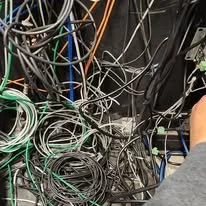
Most audio and video systems don't fail all at once. They fail over time. People often mistakenly blame failures on equipment and operators. If your system's wiring went in ten, fifteen, or twenty years ago, those small annoyances are often the first signs it's time to plan an AV system upgrade, starting with the infrastructure behind the walls, above the ceiling, and under the floor, not just under the desk, on the stage or studio.
Cable Doesn't Last Forever
Copper cable isn't the best conductor, but it is inexpensive and takes a beating. That’s why it is used in just about every industry. Cables and connectors oxidize when exposed to oxygen. Copper cables, especially those made from “cheap” materials, have memory. The cable has a way it likes to roll and lay when unrolled. Cables and connectors that haven’t moved in years can make noise when you move them or re-patch them. When shielding or ground connections break, you can hear hum and RF (radio).
Audio isn’t the only thing affected. Video can jitter, lose sync, and show color issues when cables are damaged. Depending on the cable type, you can lose the video picture completely, just like data when connections break between computers, switches, and routers.
Patch cables, portable cables, and snakes get stepped on, rolled over by carts, and flexed repeatedly at the same spot near the connector. Over time, fine strands break inside the jacket, shields fray, and crimp and solder joints break. Installed cable ages too: jackets get brittle near heat sources, floor pockets collect dust and moisture, and terminations loosen after years of plugging and unplugging.
The result is rarely a clean failure. It's intermittent noise, a blank screen, a channel that's lower in level or noisier than others, or a problem that only shows up when the building is cold- the kind of issue that only pops up seconds before your event begins.
Connector Corrosion: Why Plating Matters
XLR and other audio connectors usually have contacts plated in either gold or nickel (the shiny "silver" finish). Audio engineer Dave Rat digs into this in his YouTube video "Gold vs Silver (Nickel) Audio/XLR Connectors – Which is Better?", including how connectors hold up against corrosion. It's worth watching for anyone responsible for infrastructure.
Plating wears. Plating is a thin layer, and each mating cycle wears a little away. In high-use spots like stage boxes, wall plates, and patch points, it can wear through to the base metal underneath, which oxidizes much more readily.
Oxidation raises resistance. As contact surfaces oxidize, connections get less reliable. For low-level microphone signals and phantom power, that means crackles, pops, and dropouts.
Mismatched metals are a risk. Connector manufacturer Samtec advises choosing mating connectors with similar plating in the contact areas because dissimilar metals can cause galvanic corrosion when moisture is present. In many older systems, people plugged gold-pin cables into nickel-finished jacks (and vice versa) as gear was added piecemeal over the years.
Not every old connector is bad. But a system built up over decades, with mixed brands, adapters, and plating types, deserves inspection and cleaning, and the worst offenders deserve replacement, not another squirt of contact cleaner.
Signs Your Infrastructure Needs Attention
Noise or dropouts when a cable or wall plate is touched
Hum or buzz that comes and goes, especially between rooms or buildings
Green or dark discoloration on connector pins
Feeds that only work "if you plug it in just right"
Video sparkles, flicker, or signal loss on long SDI or HDMI runs
Missing labels and documentation, so no one knows where a cable goes
Computer network connection issues
Data loss
BYOD (Bring Your Own Device) conference systems won’t charge your devices
Multiple format converters are being used to make connections, and touching them causes issues
Rebuild With Quality Connectors and CABLES
Replacing infrastructure is the time to standardize. Using one family of connectors and matching the plating to the components’ connectors throughout removes the mismatched-metal problem and makes future service far simpler.
Connectors
Advanced Sound & Communication uses connectors from the two largest de facto standard manufacturers.
Switchcraft, based in Chicago, has built American-made connectors, patchbays and cable assemblies since 1946.
Neutrik, founded in Liechtenstein in 1975 with U.S. operations in Charlotte, North Carolina, makes XLR cable and chassis connectors that are fixtures in professional audio, video, and data.
NSI Industries, based in Huntersville, NC, making connectors and tools for the data and electrical industries since 1975.
Bulk cable
What's inside the wall matters as much as what's on the end. We install cable from manufacturers we trust:
Belden, headquartered in St. Louis and founded in 1902, offers broadcast video coax rated for 12G-SDI and a broad line of fiber optic cable.
West Penn Wire, part of the Belden group since its founding in 1971, is a leading U.S. manufacturer of fiber optic and low-voltage cable, including digital and analog pro video cable.
ICE Cable Systems, headquartered in Austin, Texas, supplies AV and low-voltage bulk cable for professional installers.
Windy City Wire of Bolingbrook, Illinois, makes American-made SmartWire cable with footage markers that make clean, accurate pulls easier.
Planning an AV System Upgrade: Why Fiber for Audio, Video and data
Video is where aging copper hits a wall fastest. Each jump from SD to HD to 4K demands more bandwidth, and copper coax and HDMI have practical distance limits that shrink as formats grow. Many facilities that ran coax for standard-definition cameras now find those runs can't reliably carry today's signals from camera positions to the production booth.
Optical fiber solves several problems at once:
Distance. Fiber covers runs that copper can't, from across a sanctuary to across a campus.
No ground loops or interference. Fiber carries light through glass, not electricity, so it avoids hum from ground differences between buildings and interference from dimmers or power cabling.
Headroom for the future. Fiber can stay in place while you upgrade the equipment at each end as formats evolve.
The right converter depends on the signal:
AVPro Edge makes HDMI-over-fiber extenders such as the AC-EXO-X-KIT, an 8K-capable HDMI 2.1 extender that reaches up to 300 meters over OM4 multimode fiber, which is ideal for projectors, LED walls and confidence monitors.
Theatrixx builds its xVision converter series for live production, including 12G-SDI-to-fiber, fiber-to-12G-SDI and HDMI-to-fiber conversion, plus optical breakouts for multi-channel runs.
Blackmagic Design offers the Mini Converter Optical Fiber 12G, a bidirectional SDI-to-fiber converter that uses standard SFP modules.
Neutrik opticalCON provides rugged, dust-protected fiber connectors for portable and stage-side runs, where standard fiber connectors would be too fragile.
When we design a fiber backbone, we recommend pulling spare strands. The added material cost is small compared to opening ceilings and walls a second time, and it leaves room for more data drops, cameras, displays, or Life Safety Systems later.
A Smart Way to Replace Old Infrastructure
Audit. We inspect and test cable, connectors, wall plates, and patch points, and document what's actually there.
Prioritize. Fix the failures that affect services and events first.
Design for the next decade. Fiber for video, consistent connectors for audio, room to grow, and clear labeling.
Install and document. Clean terminations, labeled cables, and as-built drawings.
Train and support. Your team learns the system, and we stay available for service.
Upgrades can be phased; for example, run the fiber backbone during a slow season and replace the switches, converters, and extenders later.
Why Work With Advanced Sound & Communication
Since 1998, Advanced Sound & Communication has designed, installed, and serviced systems for houses of worship, schools, colleges, civic facilities, and performing arts spaces across the Kansas City metro. Our in-house analog and digital technicians troubleshoot intermittent problems caused by aging infrastructure, and our certified, OSHA-trained riggers handle overhead work safely. Our team is made up of full-time, background-checked, insured, and bondable employees with an average tenure of about ten years, with no volunteer, student, or subcontracted labor. We're an authorized dealer in good standing for everything we sell, and our mobile repair shop and tool truck reach you from Lee's Summit to Olathe.
Clean work matters behind the walls as much as on the stage. Chuck Walthall of Walthall & Associates / Builders For Christ noted our clean installation and attention to detail, exactly what you want in infrastructure you'll rely on for years. David Walters of Walters Design Group says he doesn’t have to worry when we are on the job, because we pay attention to every detail and own it.
Let's Take a Look at Your System
If your system crackles, hums, or drops out, or you're planning cameras, displays, or a livestream your wiring can't support, we can help you build a plan. Call Advanced Sound & Communication at 816.931.9525, email info@advancedsoundkc.com, or use our contact form. Send photos of your racks, wall plates, and connectors, plus any building plans, and we'll set up a consultation. You can also learn more about our design, installation, and service work.