
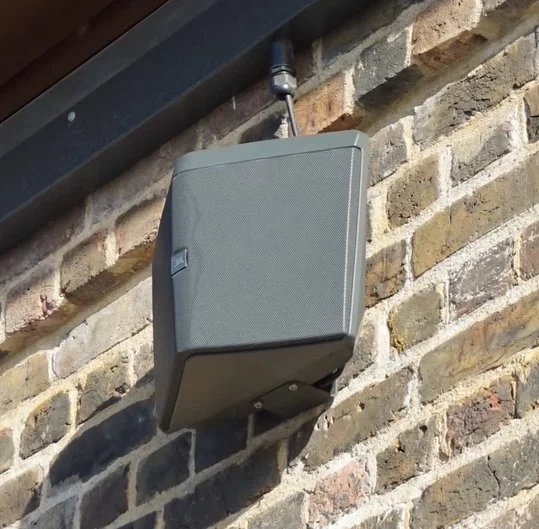
A good patio keeps tables full well into the evening. The sound system out there has a harder job than the one inside: it has to survive Kansas City summers, ice storms, and spring hail; cover tables evenly without blasting the closest ones; and stay on the right side of the neighbors. This post walks through how we approach commercial outdoor speakers for breweries, taprooms, wineries, and restaurants, and what to ask before you buy.
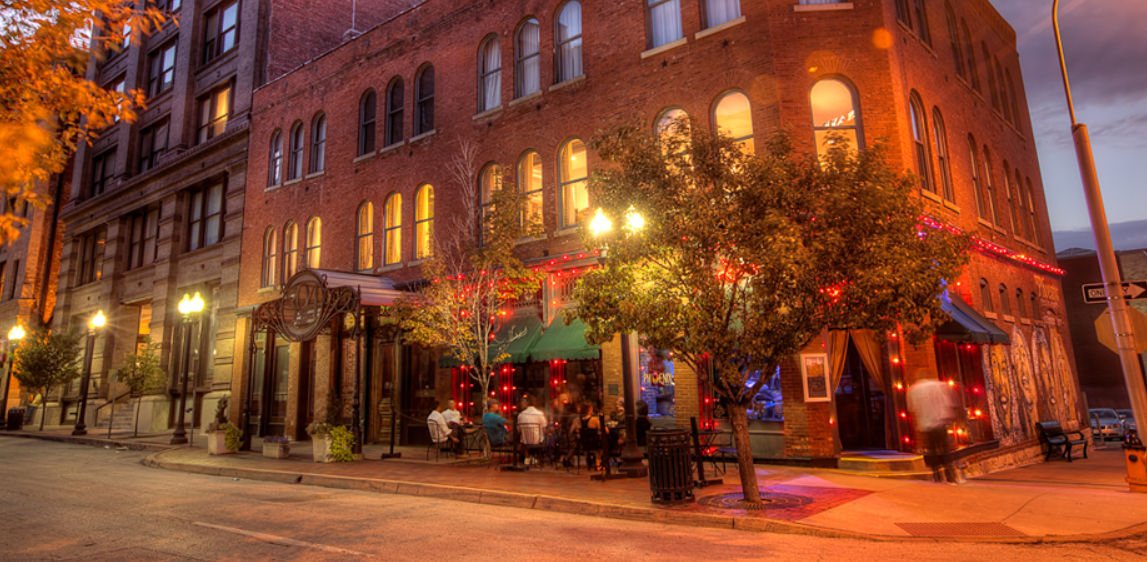
Why USE Commercial Outdoor Speakers, Not Consumer "Patio" Speakers
Consumer outdoor speakers are built for a backyard that gets used on weekends. A restaurant or club patio might run music twelve hours a day, seven days a week, from March to November. Commercial outdoor speakers are designed for that duty cycle, and they offer features businesses need: transformer taps for 70-volt operation, rust-proof mounting hardware for permanent installation, and published weather ratings you can compare from one brand to the next.
What are IP ratings?
Most commercial models list an IP (ingress protection) rating under the IEC 60529 standard. The first digit covers dust and solids; the second covers water. A 4 in the second position means protection from splashing water, a 5 means protection from water jets, and a 6 means protection from powerful jets. For a patio under a roof or deep eave, a rating like IP44 or IP45 is often fine. For a speaker fully exposed to driving rain, or one the staff hoses down at closing, look for IP55 or higher.
Most patio systems we design run on 70-volt (constant-voltage) distribution. Each speaker has a transformer with selectable "taps," so you can run several speakers on one amplifier channel over long cable runs. This lets you place the amplifier on the opposite side of the building with minimal loss of power or sound quality. We can also tap the speakers differently so that multiple speakers on the same amplifier channel can provide different volumes if needed. That matters outdoors: the speaker over the corner table near the fence can be tapped down while the ones over the center of the patio run hotter.
Low-impedance (8-ohm) operation still has its place. It is common for higher-output systems where the patio doubles as a stage, and for subwoofers. Many current commercial outdoor speakers let you choose: the AtlasIED SM82T, AUDAC WX802MK2/O, JBL Control 28-1, and RCF GS 60 all offer both transformer taps and a low-impedance bypass. That gives you room to change the design later without replacing speakers.
Choosing a Speaker Style: Surface Mount, Landscape or Pendant
The building and patio layout usually decide the speaker style. They are the most common choice. They mount to the building structure, an eave or a pergola beam, or a wall. For a large beer garden or a patio that hosts bands, a larger weather-resistant speaker may be a better fit.
Landscape satellites with in-ground subwoofers are very popular. Soundtube Rockustic Rock speakers look like organic rocks. The longer they are exposed to the elements, the more they look like natural rocks. Rock speakers blend into the landscape surrounding beer gardens, wineries, and patios. Planter speakers hold plants and look great in flower beds around patios.
Hidden speakers: SoundTube SolidDrive in walls and on glass
Sometimes the best-looking speaker is the one nobody sees. SolidDrive, a SoundTube brand from MSE Audio, makes sound transducers that mount behind drywall or onto glass and turn the surface itself into the speaker. No grille and no cutout, which suits a taproom with a design-forward interior or a restaurant whose patio is lined with windows. The SD1 mounts behind drywall on a balanced spring bracket, and the wall is taped and finished over it, so nothing shows. The SD1g attaches to glass with a high-bond double-sided adhesive disc. On a storefront or a wall of windows beside the patio, one pane can carry music to people on both sides of the glass. Transformer versions such as the SD1-T run on the same 70-volt lines as the rest of the system.
Because the wall or window becomes the speaker, sound spreads evenly and drops off more slowly with distance than it does from a conventional in-wall speaker. Each unit needs equalization for its surface, either the matching passive EQ module or a preset in the DSP, and bass is limited, so we add a subwoofer when the music calls for it. SolidDrive units are not weather-rated, so they go in interior walls and on the inside face of the glass. Placement matters too: the glass install guide calls for a large pane, about 20 square feet, with units a few inches in from the frame.
Keeping Patio Sound on the Patio
Many Kansas City-area cities, including Overland Park, Lee's Summit, Olathe and Kansas City itself, have noise rules that apply to outdoor music, and special-event or liquor permits may add their own conditions. The limits and quiet hours vary by city and sometimes by zoning, so check with your city before you design the system, not after a complaint. Generally, noise should not exceed 75dB at the property line before 7:00 a.m. and after 7:00 p.m.
We use more speakers at lower volumes rather than a few loud ones. Even coverage means no one has to turn it up to reach the far tables. We select the correct size and dispersion. We aim speakers down and in toward the center of the building, or toward the center of the space, not out toward the property line.
We pay attention to bass. Low frequencies travel farthest and go through walls. A subwoofer that is set conservatively and limited by the sound system controller after a certain hour can save a lot of trouble.
Venues often subscribe to music services. Music servers are connected to the internet. The server streams pre-selected playlists. Some services offer scheduling, so you can decide when the music volume needs to increase for “the rush,” then turn it off when the patio is closed. We can lock down the maximum level so the patio cannot exceed a specific loudness level.
Zones, Schedules and Control from the Bar
The speakers are only half the system. A digital signal processor (DSP) is what makes a patio system manageable day to day. With a DSP in the rack, the patio becomes its own zone with its own source, volume, and limits, separate from the dining room, bar, and restrooms.
Scheduling is one of the most useful features. Schedule events to run once or on a daily, weekly, or monthly basis. That means the patio can drop to a lower level at a set time every night without anyone having to remember. Staff control should be simple. A wall control panel does the same job for anyone who doesn't want to pick up a tablet or phone. Controls can be limited so a bartender adjusts within a range but can't exceed the maximum.
Ambient noise compensation
A patio is quiet at 4 p.m. and loud at 8 p.m. on a Friday. Ambient noise compensation uses a sensing microphone to measure the crowd and adjust the music or announcements to match. Gain increases as background noise rises and pulls it back down when the space quiets. Set within limits, this keeps music at a comfortable level all evening without staff riding the volume.
We can recommend speakers, a wiring approach, and controls that fit the space and the budget. Advanced Sound & Communication has designed, installed, and serviced sound systems in the Kansas City area since 1998. Our in-house, background-checked staff handles the design, installation, and long-term support, and we are an authorized dealer for everything we sell. To talk through your patio, beer garden, or taproom, call us at 816.931.9525, email info@advancedsoundkc.com, or use our contact form. You can also see some of our past work on our projects page.