
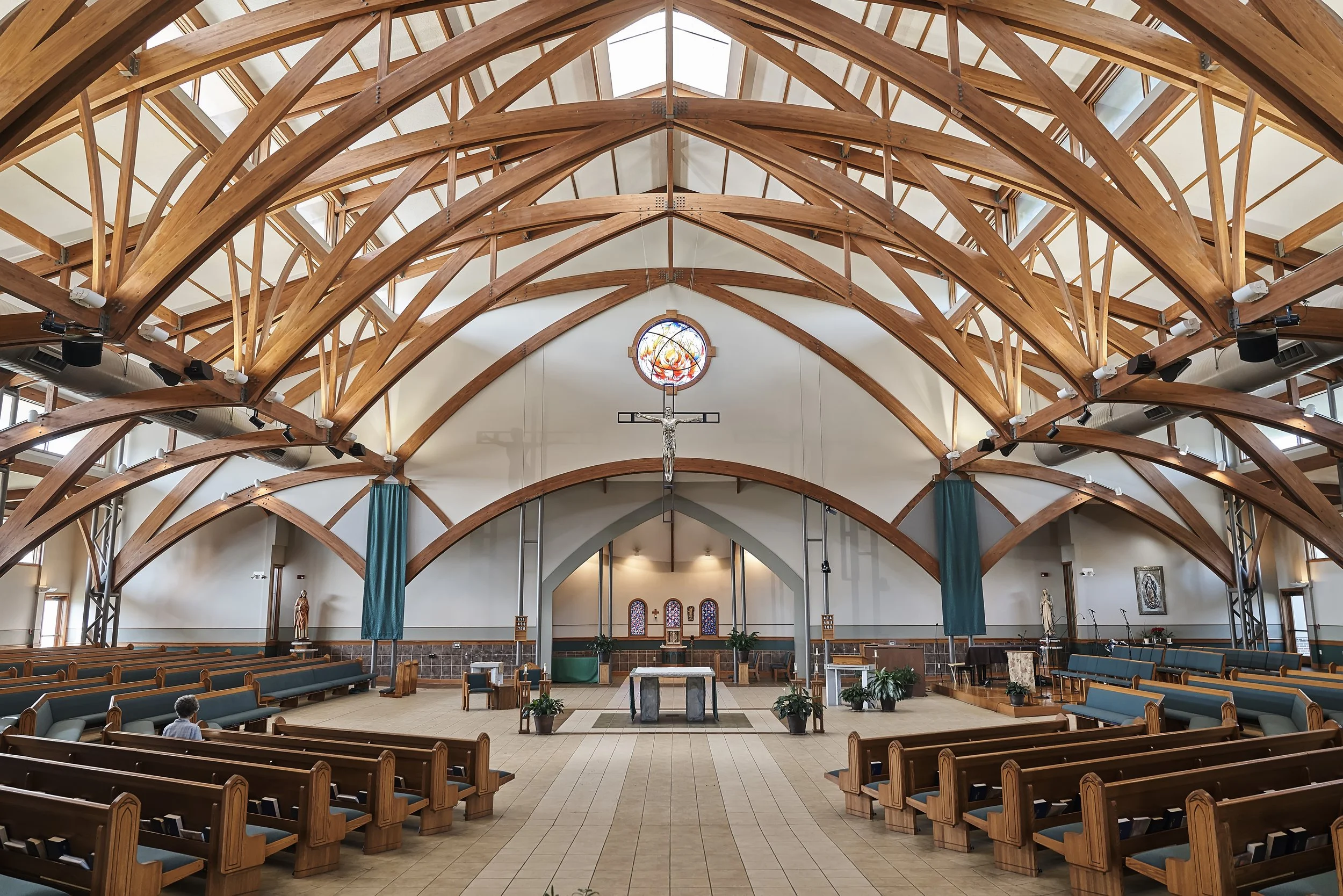
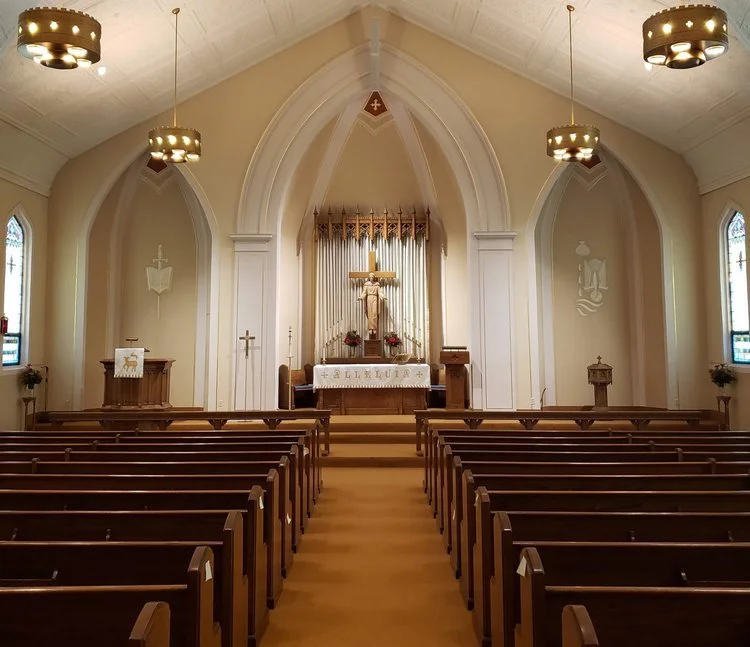
Traditional churches were often built for choral singing and an organ. The size, shape, and materials of the floors, walls, and ceiling aren’t just for aesthetics. They give traditional churches their sonic character. They also give them long, rich reverberation that flatters a pipe organ and a choir but swallows the spoken word. A reading from the lectern that sounds fine in the front pews can turn into a wash of syllables halfway back.
The job of a traditional church sound system is to re-enforce the spoken word, not music. Many approaches existed in the past. Some were better than others. Large horn-loaded speakers hung in the center of the room could efficiently reproduce the spoken word in reverberant spaces. Speakers in the bottoms of pendant light fixtures, on pew backs, or on the side walls worsened the room's problems by adding more delays.
Older traditional church buildings find new life. Young church start-ups buy these buildings and mistakenly try to reproduce loud, upbeat, modern worship in them, and they always call us asking if there is something cheap they can DIY or buy to put on the walls. Most of the time, the answer is, “No.” The room wasn’t built for it. For most, the only way it works is through deconstruction and reconstruction.
Why Reverberant Rooms Make Speech Hard to Understand
Every word is made of quick changes in sound: consonants that start and stop, syllables that rise and fall. In a reverberant room, each sound keeps ringing after it is spoken, and that tail fills in the gaps between syllables. Vowels survive. Consonants, which carry most of the meaning, get smeared. Pastors must speak slower and enunciate. The more reverberant a room is, the longer it takes for auditory systems to decipher what has been said. If older people are listening, take extra time. Increasing the PA system volume makes this worse.
How Much Reverberation Is Acceptable for the Spoken Word?
Reverberation time, written RT60, is how long it takes sound in a room to fall by 60 dB after the source stops. For speech, acousticians look mainly at the mid frequencies, the 500 Hz, 1 kHz, and 2 kHz octave bands, because that is where most of the information in speech lives. The average across those bands is often called Tmf.
Architects and acousticians design for speech intelligibility. Organ manufacturers and choral directors want as much reverb as possible. It is almost impossible to make everyone happy. One of our Catholic church clients has parishioners from other parishes attending Mass because our sound system lets them hear much better than the one at their home parish. We have heard of this happening frequently. As people age, their hearing health changes. The music isn’t as essential to them as the Homily, Scripture reading, and Prayers. One of our Catholic Church customers installed an electronic organ to add artificial ambiance to the room and preserve speech intelligibility.
There is no single right RT number for all people and spaces. Recommended reverberation time grows with room size, so a 300-seat chapel and a 1,500-seat cathedral get different targets. Speech and music also pull in opposite directions. Surveys show the recommended reverberation time for a traditional church should be 0.8 seconds for speech but 1.6 seconds for organ music. We have worked with organ companies and service techs who push for 4 seconds. Some of our Catholic cathedrals have RTs over 6 seconds.
Published guidance and field experience land roughly here:
About 1 second or less: the target for rooms where readings and sermons come first. Speech is easy to follow with modest reinforcement.
About 1.3 to 1.8 seconds: a range suggested for larger worship spaces used almost entirely for speech.
About 1.5 to 2.5 seconds: the window many traditional and liturgical rooms live in. Speech is workable here, but only with a well-aimed sound system; unamplified voices start to struggle toward the back.
2.5 seconds and up: where organ and choral music bloom. A survey of English parish churches found mid-frequency reverberation between 1.2 and 3.5 seconds, and Wells Cathedral measured 5.1 seconds. In rooms like these, intelligibility depends almost entirely on loudspeakers that put sound on the listeners and keep it off the stone.
Two practical notes. First, a full room is less reverberant than an empty one, because people, clothing and cushions absorb sound, so a room that sounds fine at a packed Christmas Eve service may be muddy at a weekday funeral. A good design checks both. Second, reverberation time is measured, not guessed. A technician plays a test signal or impulse through an omnidirectional source, records the decay at several seats, and the analyzer extrapolates the full 60 dB decay from the first 20 or 30 dB, following methods in ISO 3382.
STIPA: Putting a Number on Intelligibility
Reverberation time describes the room. It does not tell you whether a listener in row 22 can understand the reading. For that, acousticians use the Speech Transmission Index (STI), a score from 0 to 1 defined in the international standard IEC 60268-16. Scores from 0.45 to 0.60 are rated "fair," 0.60 to 0.75 "good," and above 0.75 "excellent." A score of at least 0.50 is generally considered the minimum desirable for most applications.
STIPA (STI for public address) is the practical field version. Instead of running a long full-STI test, a handheld meter listens to a special test signal for about 15 seconds. The signal is noise in seven octave bands from 125 Hz to 8 kHz, each one fluctuating at speech-like rates. Reverberation, echoes, background noise, and distortion all smear those fluctuations, and the meter calculates how much of the "speech pattern" survives the trip from the talker to the listener. The current edition of the standard was published in 2020.
How a STIPA measurement is taken
Put a talker in the pulpit. A calibrated "talk box" loudspeaker stands where the reader stands, in front of the actual lectern microphone. The standard calls for it to simulate a human voice at 60 dBA at 1 meter. That way the test covers the whole chain: microphone, mixer, processing, amplifiers, loudspeakers, and the room. If no microphone is involved, such as with recorded announcements, you can feed the signal into the system electrically.
Set the system the way it runs on Sunday. Normal service levels, normal EQ, and normal open microphones. Playing too loud hurts the result; announcements above about 80 dB tend to become less intelligible, not more.
Account for background noise. HVAC, traffic, and people all count. Meters can measure the typical background noise first and correct the STIPA result for it. Because crowd noise is irregular, a common approach is to measure the noise with people present, run the STIPA tests when the room is empty, and combine the two.
Measure where people listen. Hold the meter's microphone at listener ear height, which means seated ear height in the pews. Take readings on a grid every 6 to 12 meters (about 20 to 40 feet), depending on room size, plus the known trouble spots: under the balcony, side aisles, transepts, the back row, and the cry room.
Repeat and average. IEC 60268-16 recommends averaging at least three readings at each position when background noise is present, and any two readings should agree within 0.03.
Map and compare. Put the results on a seating plan and compare them with the computer model made before installation, so you can fix weak areas with aiming, delay, or an added fill speaker.
A STIPA score is a strong check, but it is not the whole story. It cannot tell you whether the voice seems to come from the lectern or whether the organ still sounds like the room, so measurement and careful listening go together.
Steerable Column Speakers for Traditional Church Sound
In an existing reverberant room, you usually cannot shorten the reverberation time much without changing the look of the building. The next best thing is a loudspeaker that puts sound only where the people are. For many stone-and-plaster rooms, that is a digitally steerable column array: a tall, narrow loudspeaker with many small drivers stacked vertically, each with its own amplifier and DSP channel. By adjusting timing and level across those drivers, the column shapes a tight vertical beam and aims it down at the seating, keeping energy off the ceiling, upper walls, and back wall where it would only feed the reverberation. More direct sound and less reflected sound is exactly what raises an STI score. The column itself can hang flat against a pillar while the sound is aimed downward electronically.
Several manufacturers build these for exactly this kind of room:
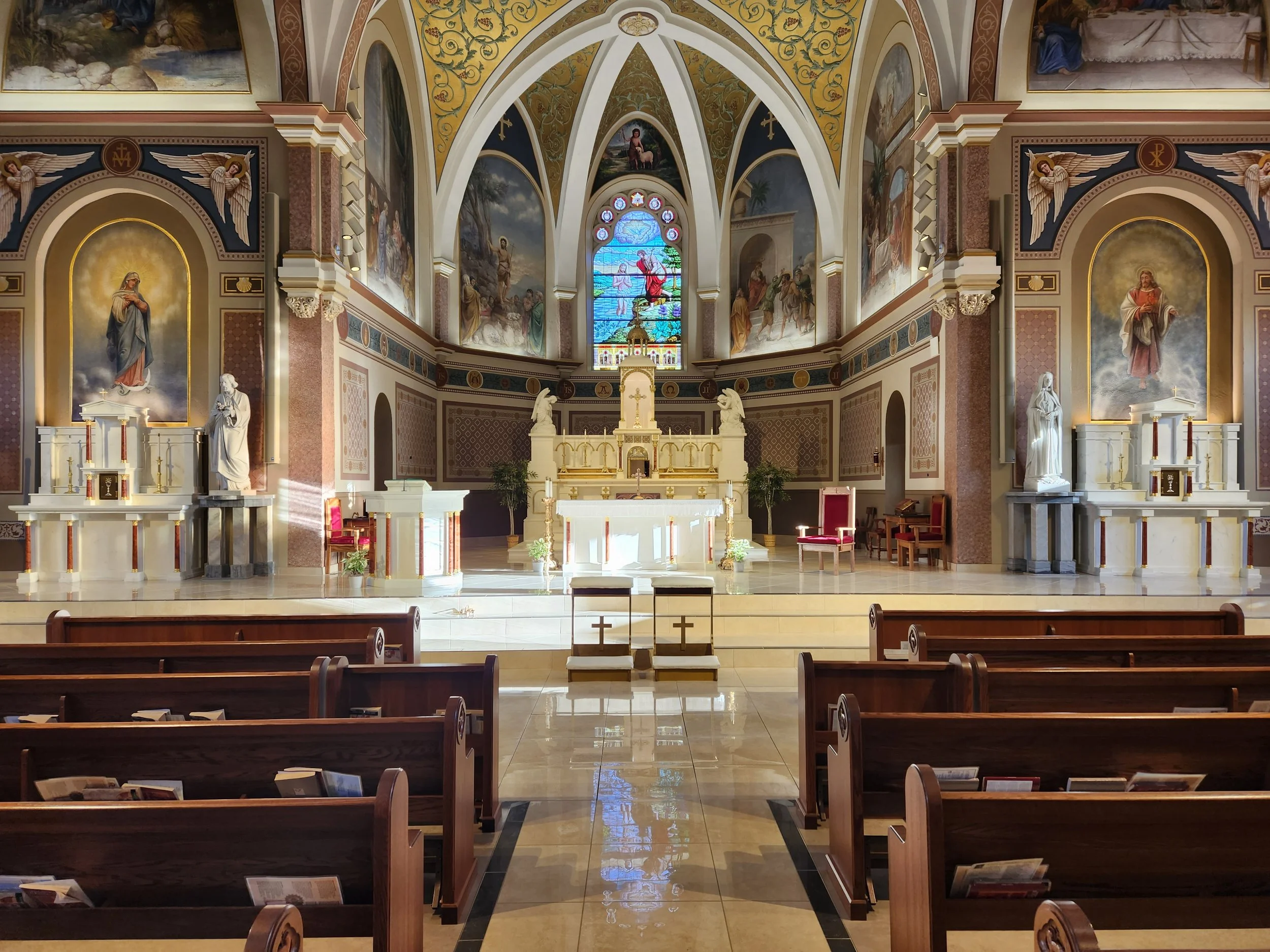
St. John The Baptist Catholic Parish, Beloit, KS with two Renkus-Heinz IC24 Speakers.
Renkus-Heinz ICONYX Gen5 (designed and built in Foothill Ranch, California) is one of the established names in steerable arrays. Its beam steering directs sound at the audience in reverberant or architecturally challenging rooms. In one cathedral installation, two IC32-RN columns were color-matched to the marble and steered to keep sound off the reflective walls, and each column can form multiple beams to cover a main floor and a balcony from one cabinet.
AtlasIED ALX columns (AtlasIED is based in Phoenix, Arizona) offer individual DSP and amplification per driver, vertical steering of plus or minus 40 degrees, adjustable opening angle, split beams, and Dante/AES67 inputs. AtlasIED lists traditional houses of worship among its target applications.
EAW AC6 ADAPTive columns (EAW is based in Franklin, Massachusetts) belong to EAW's ADAPTive line, which builds each loudspeaker from many separately powered and processed drivers and shapes the coverage to the seating in EAW's Resolution software. Each AC6 has six 6-inch woofers and thirty 1-inch tweeters, a 120-degree horizontal pattern, and a stated range of 65 Hz to 20 kHz; units can be stacked into taller columns or combined with EAW's larger Anya and Anna ADAPTive arrays for big rooms. At St. Bartholomew's Church in New York City, four color-matched AC6s in one front-facing vertical array, plus small satellites for the balcony and chancel, were designed in Resolution to keep acoustic energy off the walls and ceiling, and commissioning measurements matched the model.
The right choice depends on room length, ceiling height, balconies, and budget, so we model the actual room before recommending a product.
Horn-loaded columns: Danley SBH-10
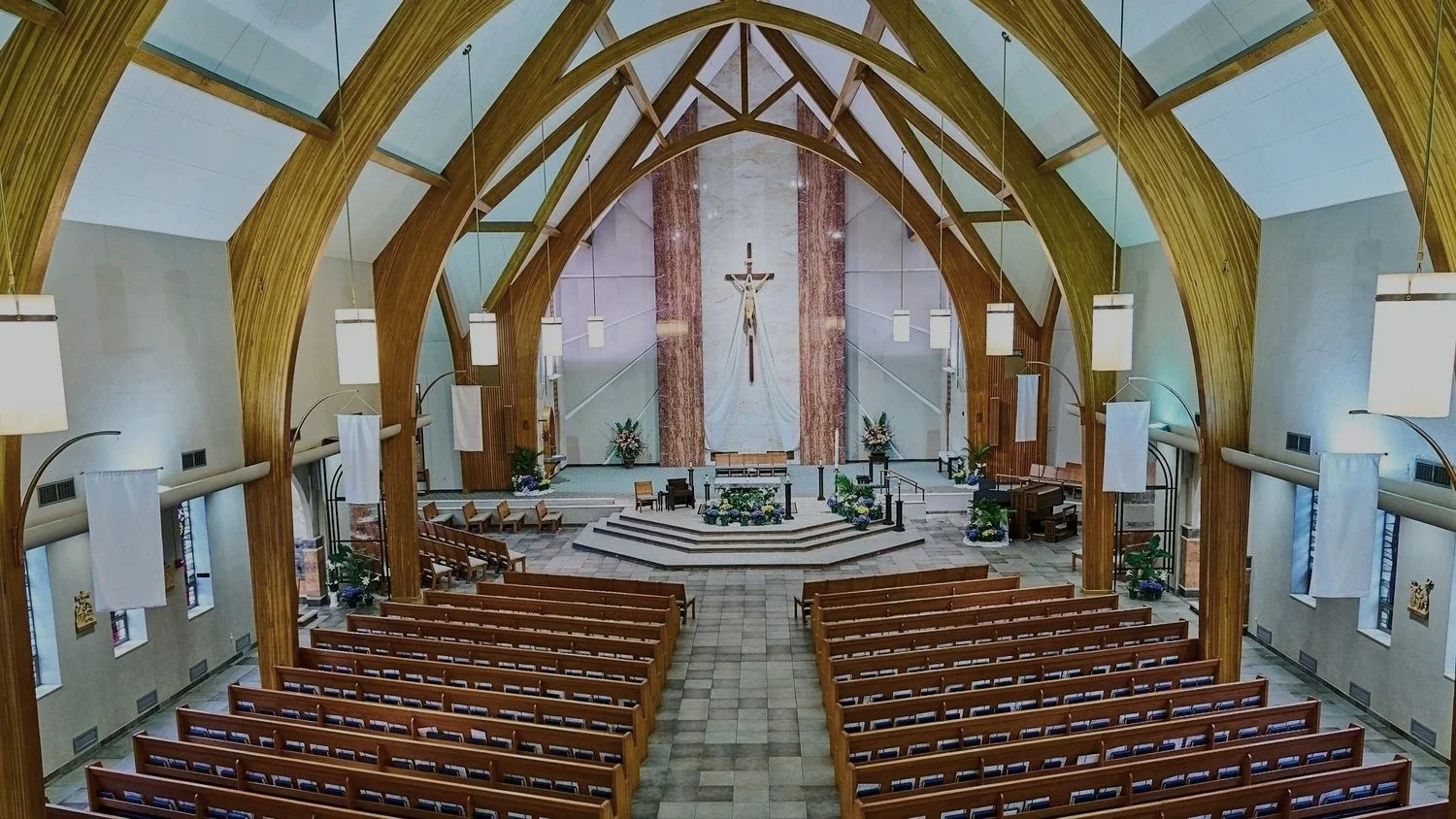
Queen of the Holy Rosary, Overland Park, KS, with two Danley SBH-10 custom-painted speakers and a TH115 subwoofer.
Steering is not the only way. Danley Sound Labs (Gainesville, Georgia) takes the horn-loaded approach mentioned above and fits it into a slim column. The SBH-10 is 60 inches tall and about 10 inches wide. Its eight 5-inch coaxial drivers work together as one large horn, using Danley's patented Paraline design, with an effective path length of more than 25 feet. The result is a fixed 140-degree horizontal by 10-degree vertical pattern and a stated response of 77 Hz to 15 kHz (±3 dB). It runs from a single amplifier channel and needs no special beam-steering processing, which keeps it simple to own and service. We have them installed in many Catholic, Bible, and Presbyterian churches. SynAudCon conducted a shootout of the industry's best steerables. Danley was excluded from the shootout because it was not a steerable speaker. But Pat Brown said, “Leave it to Danley to bring a cannon to a knife fight”.
distributed systems
In long, low-ceilinged chapels or rooms with many side aisles, a distributed system of smaller speakers placed close to listeners can work well, since each runs at a lower level and less sound reaches the reflective surfaces. The trade-off is more speakers to place, wire, and hide. Many sanctuaries use a combination: steerable columns for the main seating and small fills for transepts, side chapels, or a narthex.
The New Approach: Build the Room for Speech, Add the Cathedral Electronically
For generations, a sanctuary's acoustics were a compromise. Designers picked one reverberation time that was a little too long for the sermon and a little too short for the organ, and everyone lived with it. A newer approach starts from a simple fact: you can add reverberation to a room electronically, but you cannot take it away. So more churches are building, or treating, their sanctuaries to be clear and controlled for speech, then installing an active acoustics system to bring back the reverberation of a large stone church for the organ, the choir, and congregational singing.
Active acoustics is not the same as adding reverb to the mixing console. Small microphones hung overhead pick up the sound already in the room. A processor creates early reflections and a reverberant tail from that sound, and dozens of small loudspeakers in the ceiling and walls play it back so it arrives from all around, like real reflections. Because the system works on the room itself, it helps the unamplified choir, the pipe organ and the congregation's own singing, not just whatever goes through the sound system. Settings are stored as presets, so an operator can switch from a dry, intimate setting for the homily to a long, cathedral-like setting for the anthem with one button.
Several systems are available today from ASC:
Fulcrum Acoustic Venueflex (Fulcrum Acoustic is based in Whitinsville, Massachusetts) processors handle active acoustics, object-based immersive mixing, and loudspeaker processing on one platform, managed in Fulcrum One software. Fulcrum acquired the Venueflex technology in 2023. At Bethany First Church of the Nazarene in Oklahoma City, a 1,650-seat 1969 sanctuary with a large pipe organ, a Venueflex system lets the room shift between cathedral-like reverberation for choir and orchestra and a more controlled sound for contemporary worship and the spoken word.
HARMAN FLUX:: SPAT Revolution takes a different path to a similar result. HARMAN Professional, the parent company of JBL, Crown, BSS and Soundcraft, agreed in late 2023 to acquire the French developer FLUX::, whose SPAT Revolution software was developed with the IRCAM research institute in Paris. SPAT Revolution is an object-based immersive mixing engine: each microphone or input becomes a sound object that can be placed anywhere in a virtual room and played back over almost any loudspeaker layout. Each virtual room has its own multichannel 3D reverb, with separate control of the early reflections, a second cluster of reflections and the late tail, plus perceptual controls for low-, mid- and high-frequency decay, so a mix can be given the space of a large stone church. Unlike active acoustics, SPAT works on what passes through the mixing console rather than on the room itself, so it suits a choir, organ, and instruments that are miked, in a dry room built for speech. FLUX:: MiRA measurement software adds automatic EQ to tune the immersive loudspeaker system, and the SPAT Revolution 26.04 release added cue triggering and timeline playback, making it practical to recall settings for each part of a service.
Listen before you commit.
Skeptical committees are common, and consultants often recommend visiting an existing installation first. We can take you to many churches we have done. We can demonstrate most of the approaches in the Kansas City area.
Keeping the Sound Localized to the Person Speaking
A system can be perfectly intelligible and still feel wrong if the voice seems to come from a column on the wall rather than from the reader at the lectern. In a traditional setting, listeners notice that disconnect.
The fix uses the precedence (Haas) effect: when the same sound arrives from two places a few milliseconds apart, the ear places it at whichever arrives first. With careful signal delay, the loudspeaker sound can arrive just after the natural voice or after a forward reference speaker, and the listener's ear stays on the person speaking. The effect holds when the later arrival is no more than about 10 dB louder than the first, so full localization to the live voice works best in smaller rooms where the system adds modest gain. In larger rooms, delay is still essential for keeping fill and balcony speakers locked to the main system.
Microphones for the Lectern, Pulpit and Altar
Clear speech starts at the microphone, and the closer the microphone is to the mouth, the less room reverberation it hears. Gooseneck condenser microphones remain the standard for lecterns and pulpits because they sit close to the talker without blocking sightlines. Examples include the Shure Microflex MX418 (an 18-inch cardioid gooseneck for lecterns and pulpits) and the Audio-Technica U857Q series, with a line-cardioid element and quick-mount bases that plug into a panel connector. For a table or altar surface, a small cardioid boundary microphone such as the Sanken CUB-01 (about 1.3 inches across) can pick up speech while staying almost invisible.
Ear set/head set microphones connected to wireless microphone transmitters give clergy freedom to move, and they sit closer to the mouth. They allow for more gain and less feedback than a lapel mic. Audix, Audio-Technica, Countryman, Point Source, Shure, Sennheiser, and others offer many great options.
Gain before feedback and automatic mixing
Every open microphone increases the risk of feedback and adds room reverberation to the mix, which lowers intelligibility. In a service with a lectern, pulpit, altar, and celebrant's lavalier, only one or two are usually in use at a time. An automatic mixer handles this by keeping the active microphone open and turning down the rest. Biamp's documentation explains the standard rule: total gain is reduced by 3 dB for each doubling of open microphones, which keeps overall level steady and preserves gain before feedback. Gain-sharing automixers are available in DSP platforms from Allen & Heath Biamp, BSS, QSC, and Symetrix, among others.
Choir and Organ: Reinforce Lightly or Not at All
A good choir in a good room usually needs no reinforcement for the people in the pews. If the room is large or the choir is small, light reinforcement can help, but the goal is support, not amplification. Overhead condenser microphones such as the Shure MX202 are common because they are discreet. Shure recommends using as few choir microphones as possible, placing the center mic about 2 to 3 feet in front of the front row, and spacing additional mics using the 3:1 rule to avoid phase cancellation. A properly placed cardioid choir mic can cover roughly 15 to 20 singers.
The pipe organ is designed to fill the room on its own, so it is usually not amplified at all. In a room built dry for speech, the right tool for the organ is room enhancement, not amplification. The organ and choir microphones still earn their place, though. They feed recordings, livestreams, overflow rooms, and hearing assistance systems, which deserve their own balanced mix separate from the in-room system.
Hearing Assistance in Traditional Churches
Reverberation affects listeners with hearing loss far more than it affects everyone else. An assistive listening system sends a clean feed straight to a receiver, hearing aid or phone, bypassing the room entirely. Options include FM and infrared receivers, hearing loops for hearing aids with a telecoil, Wi-Fi streaming to personal devices, and newer Auracast broadcast systems.
Listen Technologies offers Auri, an Auracast transmitter-and-receiver system for houses of worship and theaters, and ListenWIFI for streaming to personal devices. Williams AV makes FM, infrared, hearing loop, Auracast, and Wi-Fi products. Religious organizations are generally exempt from Title III of the ADA, but many congregations provide hearing assistance anyway, and organizations that receive federal funding or rent space to outside groups may have obligations. We can help you sort out what fits your building and your members.
Respecting the Architecture and the Building's History
In a historic building, how the system looks and how it is installed matter as much as how it sounds. A few practices we follow:
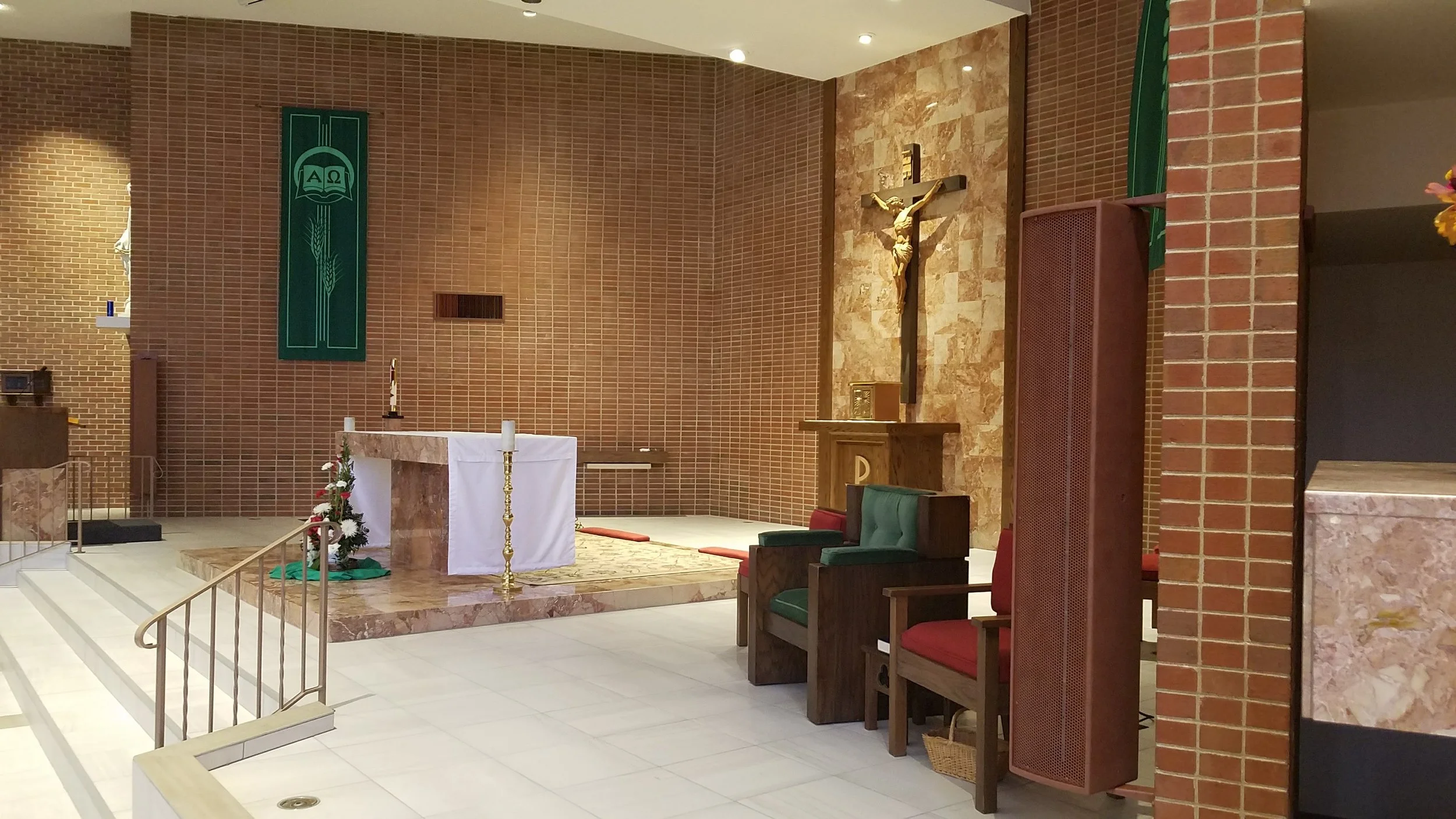
St. Gabriel the Archangel Catholic Parish with two Danley SBH-10 speakers and TH118 subwoofer.
Color-match or paint loudspeakers to the stone, plaster, or wood behind them. We have a great in-house custom painter, Matt Bennett. Matt has painted hundreds of speakers to match the walls and beams of many churches.
Concealing when possible. Exposing speakers is a last resort. We have even concealed them in plain sight, built into the shape of a cross.
Plan cable paths that use existing chases, conduit, and floor access, and avoid drilling into decorative stone, plaster, or woodwork where possible.
Coordinate with your building committee, preservation consultant, or diocese early, since some historic buildings require approval for any visible change.
Keep controls simple, with presets for a spoken service, a choral service, a wedding, or a funeral.
Service and Support for Your Church Sound System
These systems stay in service a long time. Lectern cables wear out, firmware needs updates, and settings drift. Our in-house technicians service what we install, and we can tune an existing system that no longer performs as it should.
Advanced Sound & Communication has served houses of worship across the Kansas City area since 1998 with full-time, background-checked and insured employees, never subcontracted or volunteer labor. You can see examples of our work in the projects and blog sections of our site, as well as on Facebook.
If speech is hard to follow in your sanctuary, you are planning a new building or renovation, or you want to know whether active acoustics makes sense for your room, call us at 816.931.9525, email info@advancedsoundkc.com, or send us a message. We will visit, listen to the room with you, and talk through options that fit your building and budget.